The verdict
Is the capoeira night at Mestre Bimba's school worth it?
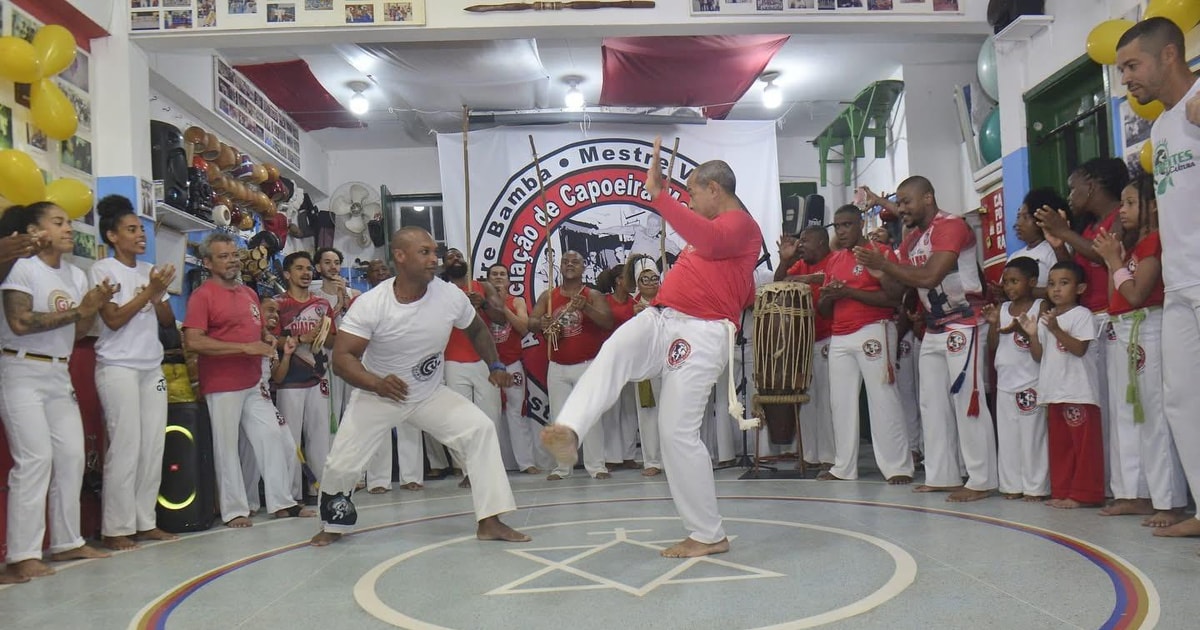
Yes. For about an hour on a Friday you watch a live capoeira roda inside the school Mestre Bimba founded in Salvador, played by its mestres, students and practitioners, with the berimbau setting every game, then samba and drumming, then fresh fruit and a chance to talk to the players. Its guests give it 4.9 out of 5, and you can cancel without charge until 24 hours before.
Five reasons the hour is special
In the school's own words
The Associação de Capoeira Mestre Bimba writes: "This is not a choreographed tourist show." It adds that every roda is different, shaped by the energy of the musicians and players in the moment.
The berimbau calls the game
Wikipedia says the berimbau's rhythms decide the game: banguela asks for a low, tricky one, São Bento grande for speed and strength. Watch the players change when the bow does.
Where capoeira went to school
Wikipedia credits Bimba with capoeira's first teaching method and dates this school on Rua das Laranjeiras to 1942. The booking page calls it Brazil's first capoeira school, founded in 1937, the year Bimba registered it.
Samba and drums too
The hour also brings the rhythms of samba, live traditional drumming and acrobatic demonstrations, so there is more than one energy in the room.
Time with the players
Afterwards the school serves fresh fruit and makes room to talk, which is the moment to ask what you have just seen, or to book a class.
Reserve
The capoeira night, and four more ways into Bahia
The capoeira night comes first. After it, the same school's class and workshops for anyone who wants to move, and a walk that explains Pelourinho before the roda.
-
The capoeira night at Mestre Bimba's school
A live roda with the school's mestres and students, berimbau and drums, samba, then fresh fruit and time to talk. About an hour, on Fridays.
See dates ↗ -
Beginner capoeira class at the same school
An hour on the floor learning the ginga, attacks and defences. No experience needed, plenty of sweat, and a souvenir to take home.
See dates ↗ -
Samba da Bahia workshop
Bahian samba from its Afro-Brazilian roots, taught for beginners in Bimba's hall. No partner and no dance background needed.
See dates ↗ -
Afro-Brazilian drumming workshop
Learn traditional Bahian rhythms on percussion in a hands-on group session, in the same school.
See dates ↗ -
Pelourinho walking tour
A guided walk through Salvador's historic centre, the streets and squares around the school, best done in daylight before the roda.
See dates ↗
More to book in Salvador
Inside the circle
What you are watching in the roda
The game moves fast, so here is the background in ten short notes: the circle, the music, the school and the samba, as the sources describe them.
- The circle
A ring of players and music
Wikipedia describes the roda as a circle of capoeiristas and instruments in which everyone sings and claps. Two players shake hands, enter and play in the style the rhythm asks for.
- The game
Played, not fought
Capoeiristas speak of playing (jogar), not fighting, Wikipedia says. The game is about body dialogue and showing skill, not knocking the other player down.
- The bow
The berimbau leads
A single steel string on a wooden bow, with a gourd resonator, struck with a stick while a coin or stone changes the pitch. Wikipedia says it joined capoeira in Bahia in the early 20th century.
- The toques
Rhythm sets the style
Banguela calls for a low, tricky game, Iuna for acrobatics and São Bento grande for speed and strength, according to Wikipedia. The other instruments follow the berimbau.
- The songs
Call and response
Songs are in Portuguese. The ladainha opens the roda as a solo, the corrido is answered by the chorus, and the quadra repeats one verse four times with replies.
- 1932 to 1942
Bimba's schools
Wikipedia dates Bimba's first school to 1932, his state registration to 9 June 1937, and the school on Rua das Laranjeiras, still open today, to 1942.
- Regional
What Bimba changed
He reshaped capoeira into the style he called Luta Regional Baiana, later capoeira regional, with teaching sequences, white uniforms and the batizado, the first game a student plays to the berimbau.
- 2014
World heritage
UNESCO added the capoeira circle to its intangible heritage list in 2014, calling it a place where knowledge and skills are learned by observation and imitation.
- Samba
Samba de roda
Bahia's circle samba developed in the Recôncavo in the seventeenth century, UNESCO says: dancers take turns in the middle of a clapping, singing ring, often inviting the next in with the umbigada.
- Etiquette
Watching well
Wikipedia's roda article says those around the circle keep it round and give the players energy by clapping and singing. Stay at the edge and keep the middle clear.
Drawn from the English-language Wikipedia articles on capoeira, the berimbau, the roda, Mestre Bimba and Pelourinho, and from UNESCO's entries on the capoeira circle and samba de roda. Each guide names its sources.
Watch or train
Watch a roda or take a class: which way into capoeira?
Both are sold by the same school, in the same hall, for about an hour, with free cancellation. The difference is whether you sit at the edge of the circle or stand in the middle of the floor.
From the booking page
Everything the booking page lists
Read on the booking page on 26 November 2026. If it reads differently when you book, the booking page wins.
- The roda
- A real Capoeira Roda, played by local mestres, students and practitioners who live this tradition every day.
- Not staged
- The provider writes that this is not a choreographed tourist show, and that every roda is different, shaped by the musicians and players in the moment.
- The music and dance
- Live berimbau and traditional drumming, the rhythms of samba, and acrobatics, music and cultural demonstrations.
- Watching, not a lesson
- The night is for watching and listening. It does not include a structured lesson or beginner training; classes are sold separately, including on the same day, subject to availability.
- Afterwards
- Fresh fruit, and space for everyone to talk and share the energy of the night.
- The setting
- The listing calls the venue the historic first capoeira school in Brazil, founded in 1937 by Mestre Bimba, creator of Capoeira Regional.
- Meeting point
- At the Associação de Capoeira Mestre Bimba. No pick-up service. Nearby landmarks: the Ó Paí Ó restaurant and the São Domingos de Gusmão church in Largo do Terreiro de Jesus.
- Length and language
- About an hour, hosted in English and Portuguese.
- Your phone number
- Give a valid WhatsApp number with your country code. The school uses it to confirm details and share information about the night.
- Not included
- Lessons or beginner training, hotel pick-up and drop-off, and meals and drinks.
- Cancelling and paying
- Cancelling costs nothing until a day before the night, and a place can be held now with payment later.
Lowest starting price seen on 26 November 2026; the total for your Friday is shown at checkout.
Friday, step by step
From booking to the last song
Pick a Friday
Open the calendar, choose a Friday with places and hold it with pay later while the rest of the trip settles.
Add your WhatsApp
Enter a WhatsApp number with your country code. The school sends its confirmation and details there.
Find the Terreiro de Jesus
Make your own way to Rua das Laranjeiras in Pelourinho. The São Domingos de Gusmão church and the Ó Paí Ó restaurant are your landmarks.
Watch, clap, stay for fruit
Keep to the edge of the circle, clap with the berimbau, then stay for the fruit and ask the players about what you saw.
Guides
Six guides to the roda, its music and its school
- The answer, with sources Is the capoeira night at Mestre Bimba's school worth it? The Friday roda in Pelourinho, explained What happens at the Friday capoeira night in Salvador, who plays, what the music is, what the school is and why it matters, and what the booking covers. Read the guide →
- Two ways in Watch a roda or take a class: which way into capoeira at Mestre Bimba's school? The Friday capoeira night and the beginner capoeira class are sold by the same school in Pelourinho. What each one offers, who should pick which, and how to combine them. Read the guide →
- History Mestre Bimba and capoeira regional: the man behind the school in Pelourinho Who Mestre Bimba was, how he reshaped capoeira into the regional style, why 1932, 1937 and 1942 all matter, and what his rules still mean in the roda you watch. Read the guide →
- The music The berimbau and the music of the roda: what you hear at the capoeira night The berimbau, pandeiro, atabaque and agogô, the three kinds of capoeira song, how rhythms change the game, and the samba de roda that follows in Bahia. Read the guide →
- Getting there Finding Mestre Bimba's school in Pelourinho, and planning the evening around it Where the capoeira night meets, the landmarks on the Terreiro de Jesus, what Pelourinho is, and how to fit dinner and a daytime walk around a Friday roda. Read the guide →
- Before you book Before you book the capoeira night: dates, WhatsApp, what is included and roda manners The practical side of the Friday capoeira night at Mestre Bimba's school: which days, what the booking includes and leaves out, the WhatsApp step and how to behave at a roda. Read the guide →
Questions before you book the capoeira night
Is the capoeira night at Mestre Bimba's school worth it?
Yes. You watch a live roda in the school Mestre Bimba founded, played by its mestres, students and practitioners to live berimbau and drums, with samba to follow and fresh fruit afterwards. The school stresses it is not a choreographed tourist show. The night holds a 4.9 out of 5 score from guests, and cancelling costs nothing up to a day ahead.
Which ticket should I book?
The night has a single booking type, priced per person. Choose the night to watch a roda, or the school's separate beginner class if you want to train; both are listed in the booking section, and you can book both for the same Friday if there is space.
Which days does the capoeira night run?
Fridays. On 26 November 2026 the booking calendar showed 4, 11 and 18 December and 8, 15, 22 and 29 January 2027, with no date on 25 December or 1 January. Start times sit beside each date in the calendar.
Where is Mestre Bimba's school?
On Rua das Laranjeiras at the Terreiro de Jesus, in Pelourinho, Salvador's historic centre. The booking page names the Ó Paí Ó restaurant and the São Domingos de Gusmão church as nearby landmarks. There is no pick-up.
How long is the capoeira night?
About an hour. The listing's itinerary allows up to an hour and a half at the school, so leave a little time before dinner.
What is included?
Entry to the school, watching a live capoeira roda, live capoeira, samba and drumming presentations, and fresh fruit afterwards. A lesson, meals, drinks and pick-up are not included.
Will I have to take part?
No. The night is for watching and listening, and it is not a lesson. If you want to move, the same school sells beginner capoeira, samba and drum classes separately.
Is it a staged show?
The provider says it is not a choreographed tourist show but a gathering of people who practise capoeira, and that every roda is different.
Why do I need a WhatsApp number?
The booking page asks for a valid WhatsApp number with your country code. The school uses it to confirm the reservation and send details about your night.
What language is it in?
English and Portuguese. The capoeira songs themselves are sung in Portuguese.
Can I cancel or pay later?
Yes on both counts. A cancellation costs nothing until 24 hours ahead, and payment can wait until later.
Can I take photos?
No photo rules appear on the booking page. Shoot from the edge, keep out of the circle, and follow any request from the mestre on the night.
Who was Mestre Bimba?
Manuel dos Reis Machado, the Salvador-born mestre who created capoeira regional and its first teaching method, Wikipedia says. He died in 1974.